A brown patch appears in the lawn. The usual sequence is to treat it as a disease, then as a nutrient problem, then eventually to get a quote for replacing the sod. Somewhere in there almost nobody does the one thing that would have answered it in ten minutes: turn the zone on in daylight and stand there and watch it.
Irrigation faults are the single most common cause of dry spots in Hillsborough County lawns, and they are almost all visible to the naked eye once the water is running. Here is what to look for.
Heads that have sunk below grade. Over a few years, soil settles and thatch builds, and a spray head that used to sit proud of the turf ends up spraying into the surrounding grass. You will see a head that is watering a two-foot circle of very green grass around itself and nothing beyond it. The dry patch is downstream of it.
Heads knocked out of alignment. A mower wheel or a car tyre rotates a head a few degrees, and a rotor that was covering a quarter circle of lawn is now putting a third of its water onto the fence or the driveway. The giveaway is a wet stripe on a hard surface and a dry wedge in the turf beside it.
Blocked or worn nozzles. A head that dribbles rather than throws, or one with a fan of spray broken by grit in the nozzle, will leave a shadow of dry grass in a specific shape. Worn nozzles also mist rather than spray, and in an afternoon breeze most of that mist never lands where it was aimed.
The one that surprises people is that sprinkler coverage is supposed to overlap — properly designed, the spray from each head reaches the next head. It is not a grid of separate circles. That means one head not working does not leave one dry circle, it leaves a weak area across everything it was meant to help cover, which is why the dry patch is often nowhere near the faulty head.
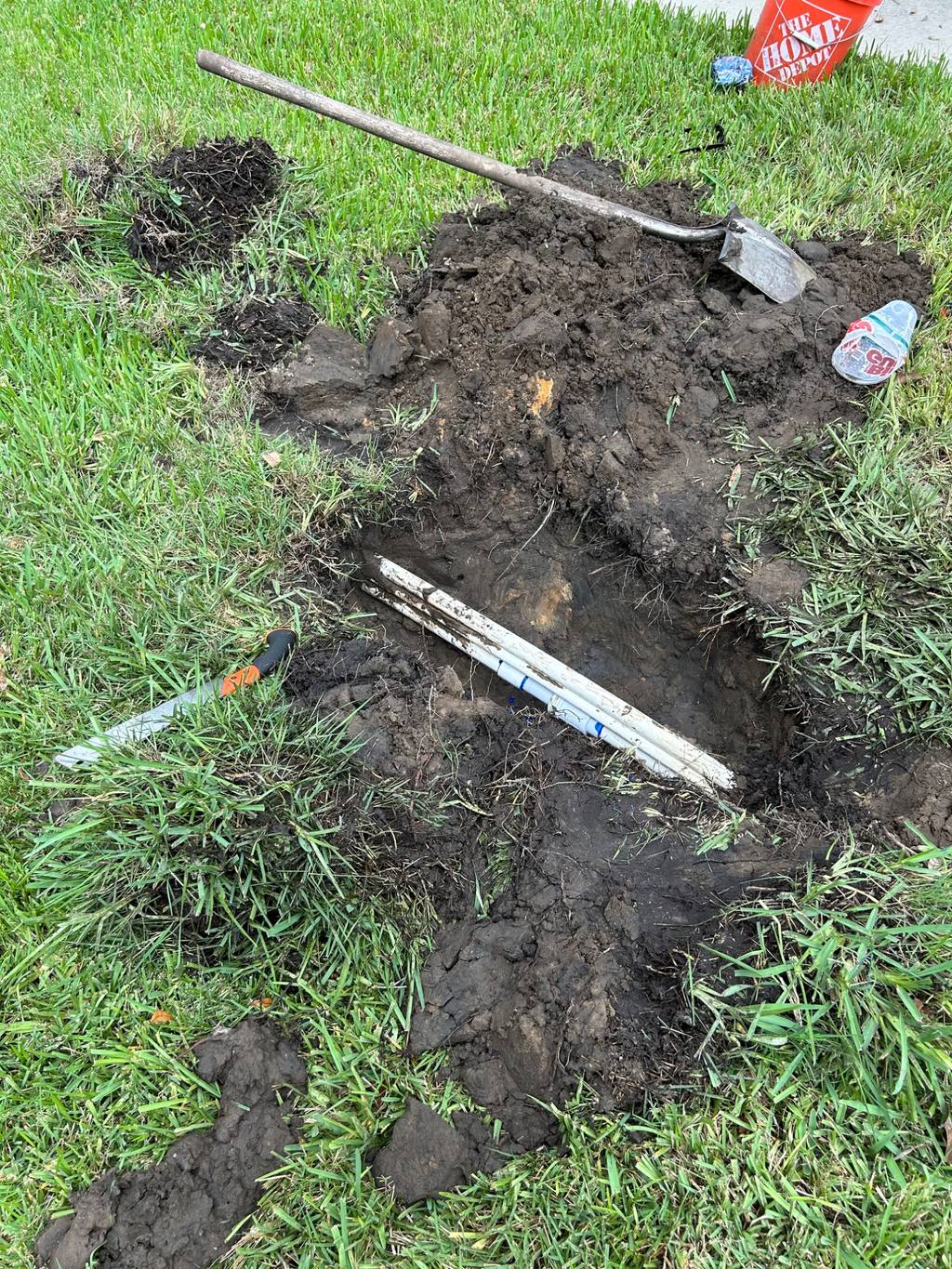
Then there are the faults underground. A wet or spongy area that never dries out, especially if the grass there is greener and growing faster than everything around it, usually means a cracked lateral line or a leaking fitting. A zone where every head comes up weakly points at a pressure problem or a valve that is not opening fully. And a valve that will not shut off completely leaves one zone quietly running long after the cycle ended, which shows up as a soggy patch and a water bill nobody can explain.
Finally, the controller itself, which is free to check and gets missed constantly. Programmes get reset after a power cut. Seasonal adjust gets left at a summer percentage through the winter. Two programmes end up running the same zones on overlapping days. And a rain sensor that has failed will either shut the system off entirely or stop doing its job — both of which show up in the lawn long before anyone thinks to look at the box in the garage.
So the honest order of operations when a patch appears: run the zone and watch it, look for the things above, fix what you find, and give it two or three weeks. In a good share of cases the grass comes back on its own, because there was never anything wrong with it — it was simply not being watered. Replacing sod on a zone that still does not cover properly just means laying new grass into the same dry spot.
Want somebody to run the zones with you? Call (813) 647-4309 and we'll test the system and quote only what's actually broken.